
How many of you have heard of Kalnik? Probably not everyone… And how many have actually been there? Perhaps even fewer… But that might be about to change!
Kalnik is a mountain located in northwestern continental Croatia. Most of its territory lies within Varaždin County, while a slightly smaller part belongs to Koprivnica-Križevci County.
Kalnik is surrounded by well-known towns such as Novi Marof, Varaždinske Toplice, Ludbreg, and Križevci.
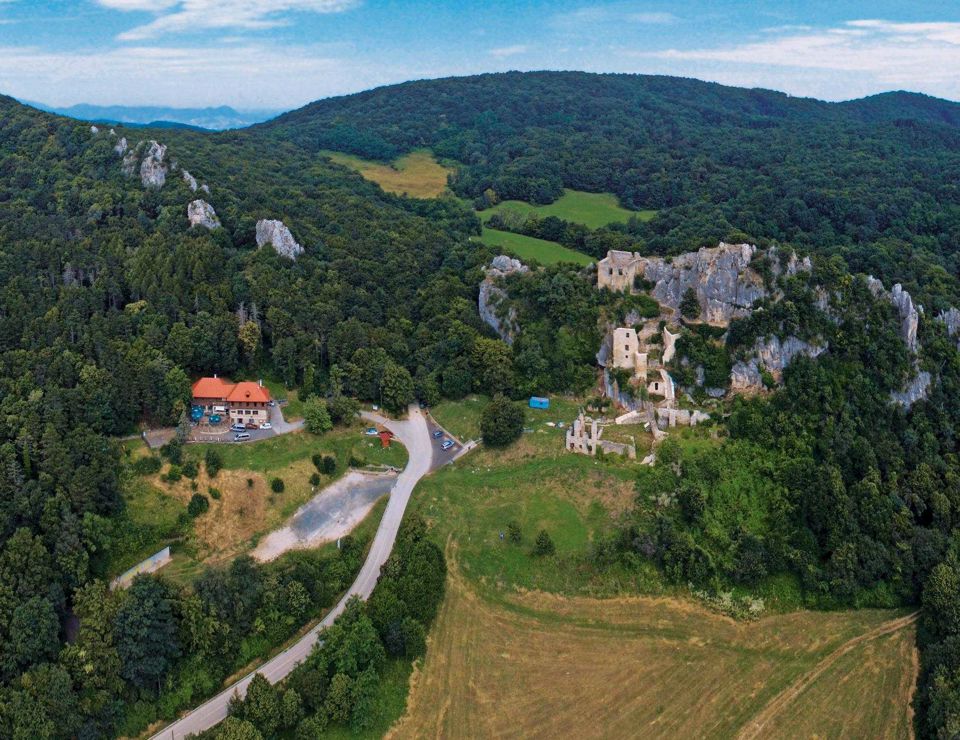
A Place You've Probably Never Heard Of but Will Want to Visit After Reading This
Let's start at the top and work our way down. If you're an experienced hiker who has already worn out more than a few pairs of hiking boots, then Vranilac Peak, the highest point of Kalnik at 643 metres, shouldn't be too much of a challenge.
And you certainly won't have trouble finding it, thanks to the distinctive antenna standing at its summit. Although, in our opinion, it does spoil the otherwise beautiful natural scenery just a little.
Next comes Peca Peak at 624 metres, followed by Škrinja at 500 metres and Pusta Barbara at 460 metres. These peaks are precisely what makes Kalnik so attractive to hikers, paragliders, and rock climbers.
Kalnik is also home to a mountain lodge, an excellent starting point for exploring the Vranilac educational trail or hiking towards Veliki Kalnik. Along the way, you'll almost certainly stop to take a few photos at the picturesque Vratno Gorge, and you can even discover three caves during your adventure.
But if you ask us, the most memorable photograph will be the one you take from the Škrinja viewpoint.
Many hikers also choose to climb Mali Kalnik, perhaps drawn by its fascinating history and heritage. This is where you'll find the ruins of Pusti Grad, an ancient fortress, while the summit area of Mali Kalnik is also protected as a special botanical reserve.
Breathtaking Views and a Legend That Refuses to Be Forgotten
Kalnik welcomed its first inhabitants some three thousand years ago, and traces of their lives can still be found at Igrišće, a small clearing just below the mountain's highest peak. Archaeologists have linked the site to the Bronze Age, suggesting that this area was already an attractive place to live, probably thanks to the natural shelter offered by its caves and the abundance of hunting grounds.
The settlement of Kalnik itself emerged during the Middle Ages, in the 13th century, developing alongside the military fortress of Veliki Kalnik. Originally, it served as a settlement beneath the fortress, known as a suburbium, called Brezovica.
Brezovica, today's Kalnik, gained an important historical status in 1367 when King Louis I of Hungary, of the Angevin dynasty, granted it the status of a "royal town". This privilege was reaffirmed several times during the 14th century, placing the settlement beyond the direct authority of the lords of Veliki Kalnik Castle.
As a result, Brezovica became an administrative centre for the Kalnik nobles from the surrounding villages, known as iobagiones uni sesionis.
The settlement experienced its greatest development around the turn of the 15th and 16th centuries. However, during the second half of the 16th century, its importance gradually declined as the Ottoman threat increasingly affected the region beneath Kalnik.
From the 17th century onwards, Kalnik continued to develop primarily as one of the larger settlements in the Križevci area.
The Plum Growers of Kalnik Who Outsmarted the Mongols with Food
The village of Kalnik lies beneath Vranilac Peak, near the parish Church of St. Brice.
Above the settlement, perched on a rocky elevation of approximately 500 metres, stand the remains of Veliki Kalnik Castle, a medieval fortress first mentioned in the 13th century.
The castle consisted of three sections, the oldest of which dates back to the time of the Mongol invasion. According to local tradition, King Béla IV sought refuge here while fleeing the Mongols.
Veliki Kalnik also played a particularly important role during the reign of King Sigismund, when it was declared a royal palace.
The castle is closely associated with Barbara of Cilli, Sigismund's wife, remembered in local folklore as the "Black Queen". According to legend, she frequently stayed at Kalnik.
The Black Queen and the Hidden Gold Still Guarded by Snakes
In local folklore, Barbara is portrayed as a cruel and strong-willed ruler who inspired fear among the inhabitants and nobility of Kalnik.
Legends describe her as ruthless, greedy, and prone to abusing her power. One particularly intriguing detail is her mysterious connection with a raven, which appears in the stories as a symbol of danger and misfortune.
Another legend claims that Barbara of Cilli secretly met with the administrator of the Kalnik estate in the Mali Kalnik area.
Their alleged relationship supposedly made the administrator increasingly arrogant towards the local nobility, who eventually complained to King Sigismund.
According to the story, the king responded by removing Barbara from Kalnik and imprisoning her in Bohemia.
The name Pusta Barbara, sometimes associated with Mali Kalnik, is also linked to this legend.
And the story doesn't end there.
Local folklore claims that Barbara left behind hidden gold, supposedly guarded by snakes to this very day.
Whether these tales reflect actual historical events is another matter. What makes them fascinating is their place in local oral tradition, adding mystery and character to a mountain already rich in history, symbolism, and folklore.
Another famous local legend tells the story of the "Plum Growers of Kalnik".
According to the tale, villagers from the settlements beneath Kalnik helped King Béla IV survive a Mongol siege by supplying him with food, particularly plums.
In gratitude, the king supposedly rewarded them with noble privileges.
The story was also immortalised by Croatian writer August Šenoa in his poem Šljivari (The Plum Growers), part of his collection Povjestice, in which he describes the Mongol invasion and their eventual abandonment of the siege.
Many historians, however, approach this legend with caution, and not everyone agrees with its historical accuracy. Nevertheless, the tale has survived through generations and remains an important part of Kalnik's cultural identity.
And if these stories have inspired you to explore Kalnik for yourself, we suggest making Destination Green Croatia your first stop, where you can discover a carefully selected collection of holiday homes and unique places to stay across continental Croatia.